


Dr Hay to URPP students: making agriculture the engine of tomorrow’s Cambodia
Publish date: 09 February 2026 / Agriculture / Author : ATH Sokren
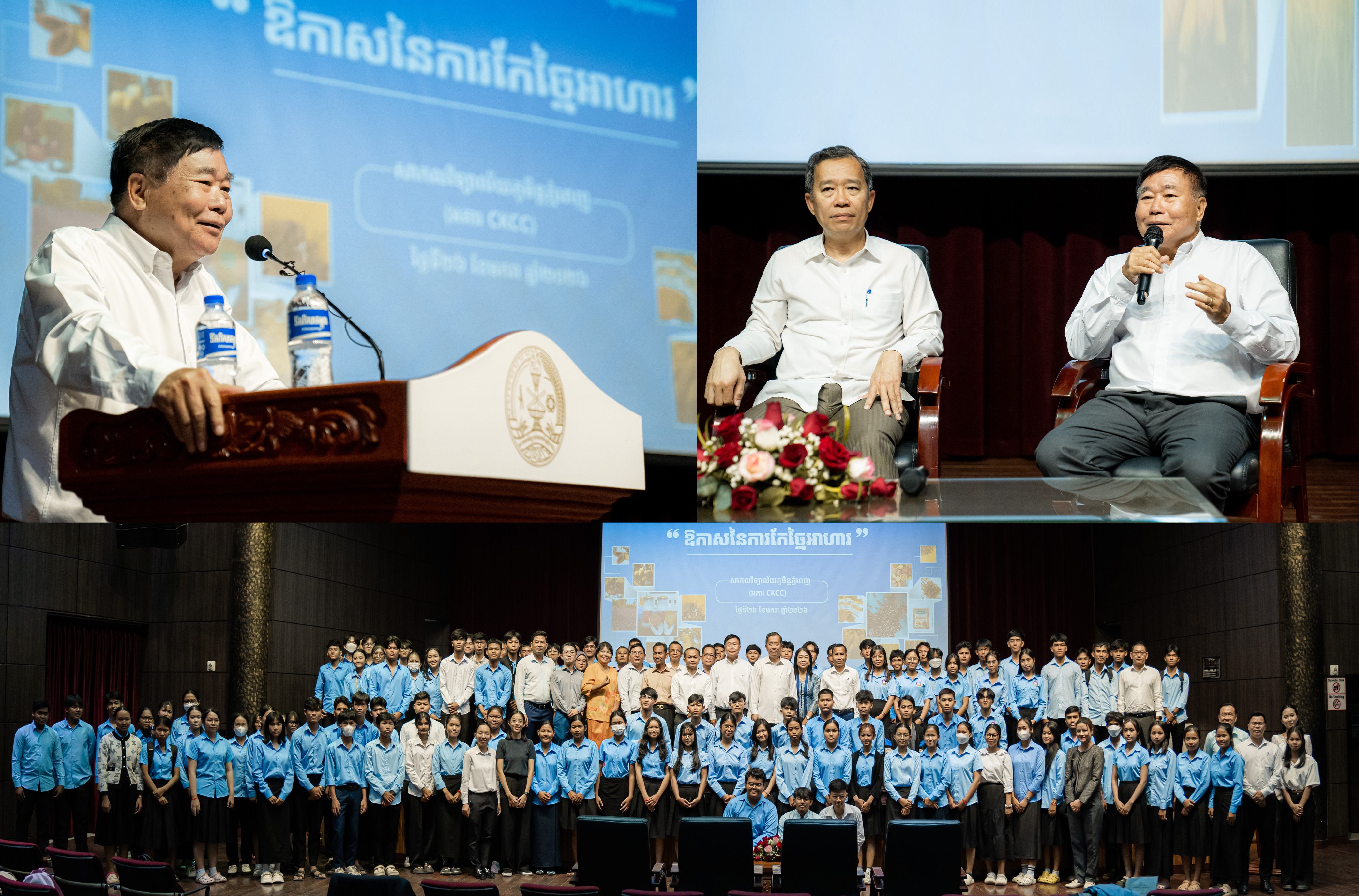
Speaking to nearly 600 students from the Royal University of Phnom Penh (URPP), gathered on 26 January 2026 at the Cambodia‑Korea Cooperation Center, Dr Hay Ly Eang delivered a highly concrete lesson in economic development, grounded in Cambodia’s recent history and his own experience as an entrepreneur. Invited to a conference on “Opportunities in food processing”, alongside Thon Vattana, Second Vice‑President of the Senate, and Sim Virak, Secretary of State at the Ministry of Economy and Finance, the founder of the PPM‑Confirel Group urged the younger generation to see agriculture and agrifood as strategic levers for the country’s future.
Reviewing the major phases of Cambodia’s economic trajectory – from independence to civil war, from the “economy on life support” during the embargo years to the opening of the UNTAC era – Dr Hay showed how the Kingdom long lacked markets, products, and processing industries. From the 2000s onwards, he noted, growth has been driven mainly by trade and assembly (textiles), leaving the country’s “core foundation” – agriculture – largely underdeveloped.
It was into this gap that PPM, in pharmaceuticals, and Confirel, in agrifood, moved, betting – in the case of Confirel – on processing local products and focusing on quality. Today, PPM ranks 11th out of 600 laboratories in French‑speaking Africa, and the group’s brands, built with local human resources, now export to around 30 countries. Confirel, founded 25 years ago, has already received eight awards, including five international prizes, for its work on traditional products such as prahok and palm sugar.
“If the road is long, you have to break it down into small sections to reach the destination,” he told students, insisting on determination, a clear vision and fidelity to Cambodian realities rather than imported theories. For him, the border crisis with Thailand was a wake‑up call that revealed both the vulnerability of an economy heavily dependent on imports and the existence of real opportunities, provided that “Khmer support Khmer” and that productive capacity follows.
Dr Hay also called for a renewed alliance between the state, citizens, and the private sector. He reminded the audience that a profitable company pays taxes that feed the national budget and urged the authorities to view the private sector as a development partner rather than a cash cow: “We must not think of the private sector as roast pork,” he quipped, prompting laughter in the room. The unvarnished message to a new generation was that they are expected to innovate, protect the legacy of previous generations, and build a more autonomous, value‑creating economy in Cambodia.
